
Canada Goose
Management

The Guardians of Mid-Island Estuaries Society leads science-based initiatives to manage locally overabundant Canada Goose populations.
Our landmark Canada Goose Management Strategy provides a framework to protect coastal ecosystems while fostering collaboration across regional governments, First Nations, and community partners.

The Challenge of
Overgrazing

In the mid-20th century, non-migratory resident Canada Geese were introduced to Vancouver Island. Without natural migration patterns or significant regional predators, these introduced populations grew rapidly.
Large concentrations of resident geese cause severe ecological stress to delicate tidal marshes. Through heavy grazing and root grubbing, overabundant geese strip native vegetation like Carex lyngbyei (Lyngbye’s sedge), leading to widespread soil erosion, loss of marsh habitat, and degradation of vital grounds for juvenile salmon and waterfowl.
The Field Research:
Data-Driven Conservation

Effective wildlife management requires clear scientific evidence.
Through population surveys, banding, habitat impact assessments, and seasonal movement tracking, GooSE’s research program continues to collect the necessary data to make informed, conservation decisions.
  • Volunteers and field researchers leg-banded, collared, and tracked hundreds of geese captured at the Englishman River, Little Qualicum River, and Craig Creek estuaries.
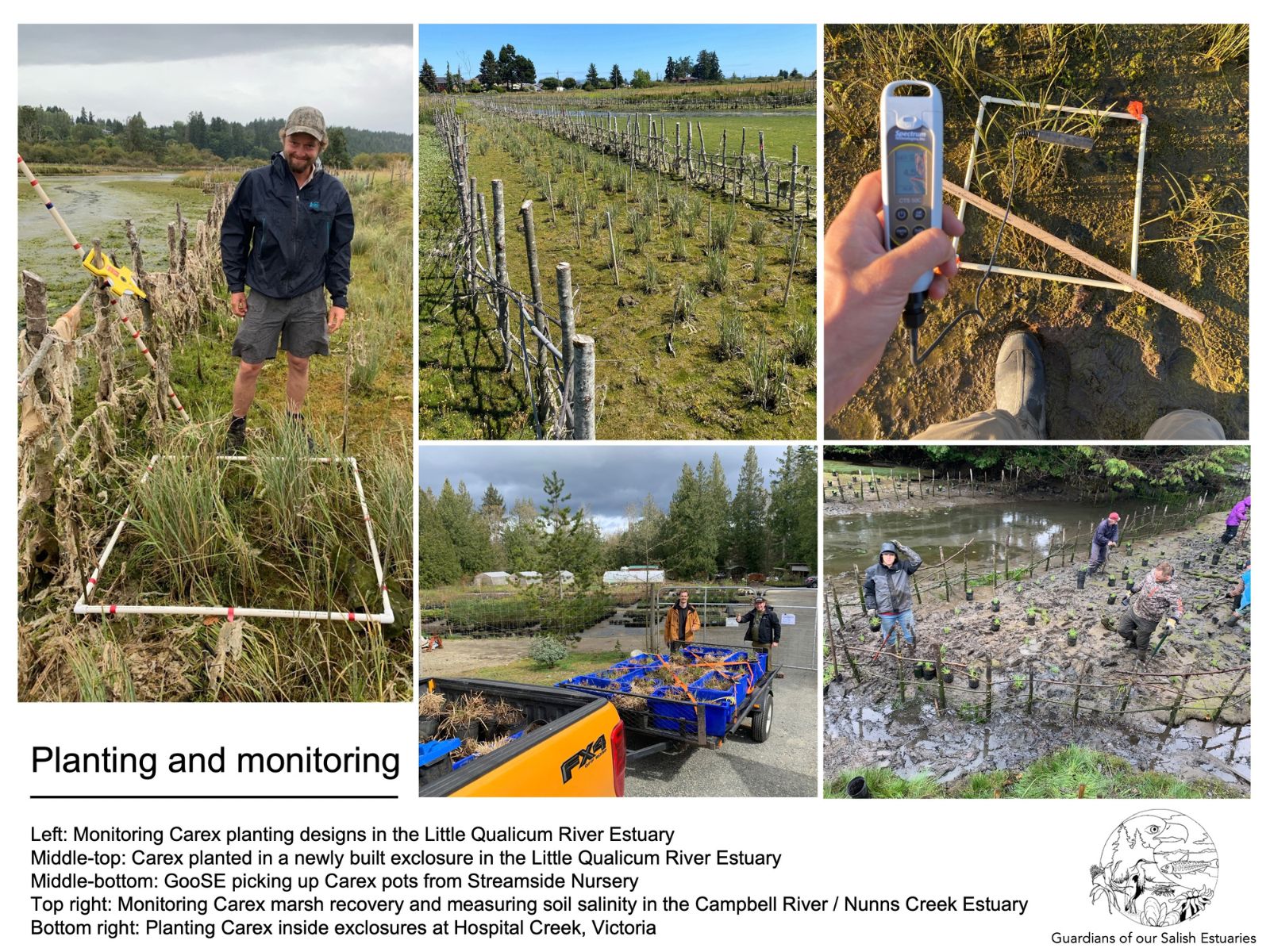
  • We conducted long-term exclosure studies to evaluate how marsh vegetation recovers when protected from goose grazing pressure.
  • We assessed how grazing by Canada Geese has changed the seedbank in soils of our estuaries, which affects regeneration of damaged estuary vegetation
  • Annual winter and moult population surveys were established to measure regional bird densities and map habitat usage across mid-Island estuaries.

The Action Plan:
Multi-Jurisdictional
Solutions

Restoring ecological balance requires a multi-faceted approach.
Our management strategy outlines coordinated solutions designed for long-term estuary recovery. This includes population control measures, collaborating with local communities, and providing evidence to help shape future policies.
  • Egg addling, regulated hunting, and strategic First Nations-led harvests to keep resident numbers within ecological carrying capacities.
  • Partnering with local First Nations to integrate traditional ecological knowledge and utilize harvested goose meat for community benefit.
  • Providing local municipalities and regional districts with data to support consistent, region-wide wildlife policies.

Download the Full Strategy

While our multi-year research and policy recommendations are summarized above, the original 2015 Canada Goose Management Strategy for the Mount Arrowsmith Biosphere Region and its supporting technical studies are available for download below: